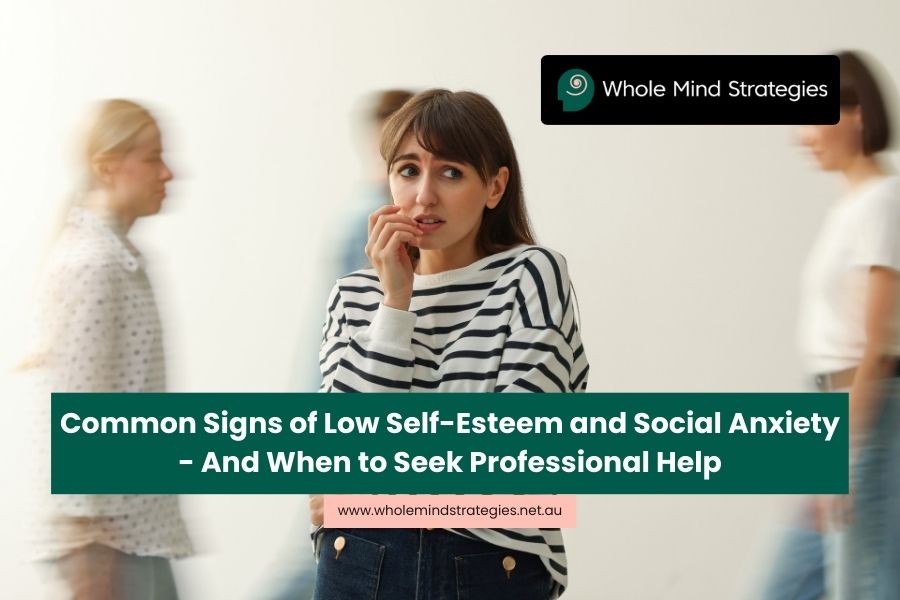
Have you ever experienced a social event that left you feeling exhausted, mentally replaying every word you uttered, and even persuading yourself that you were testing people with your behavior or were not right for them? Or do you often decline invitations because the idea of “going public” is just too much to handle? If your answer is yes, then you are not the only one. Millions of people suffer from low self-esteem and social anxiety, which sometimes remain unnoticed or get the label of “just shy” rather easily.
At Whole Mind Strategies, low self-esteem, and social anxiety issues are interconnected in almost every person who is seeking us to help them become more confident and easy-going in their relationships and career. The first step to liberation is recognising the signs.
Everyday Signs of Low Self-Esteem
Low self-esteem seldom claims attention. Rather, it is the faintest of whispers that say “you’re not good enough” in a hundred different ways:
- Constant self-criticism You would easily identify your thoughts as “I was so dumb,” “No one really cares about me,” or “I find it so hard to be the most interesting person in the room” even though the situation proves otherwise.
- Accepting compliments as a challenge When a compliment is given, your instinct is to either push away or downgrade its value: “Oh, it was just a little thing” or “You’re just being nice.”
- Fear of failure and fear of success at the same time You might not even dare to apply for a promotion because “what if they choose me and then I can’t handle it?” Or maybe even stay in the dark with your projects forever and the reason being that even if you finish them, you will be subjected to criticism.
- Chronic people-pleasing Saying yes when you want to say no, over-apologising, and feeling responsible for everyone else’s happiness are classic ways of trying to secure approval and avoid rejection.
- Social comparison on steroids Scrolling Instagram or LinkedIn can leave you feeling like everyone else is more successful, attractive, or put-together – reinforcing the belief that you’re somehow “behind.”
- Feeling like a fraud (impostor phenomenon) Even with qualifications, achievements, and positive feedback, you secretly wait for the day people “find out” you don’t belong.
???? Learn more about low self-esteem from Healthline
How Social Anxiety Manifests
More about social anxiety on Beyond Blue. Social anxiety is characterized by the fear of being evaluated, humiliated, or rejected in social or performance situations. It is not merely a matter of getting nerves – it can be extremely hard to bear physically.
Common experiences include:
- Very stressful pre-event worries Dreadful hours, days, or even weeks before the party, meeting, presentation, or even just casual coffee catch-up.
- Physical symptoms that feel beyond one’s control. A racing heart, flushed fat, sweating, trembling voice, dry mouth, nausea, dizziness, or even a total mind blank at that precise moment of concentration on you.
- Avoidance as a major method of coping strategy Refusing invitations, coming late, sitting in the last row, opting for online instead of in-person whenever feasible, or making up flimsy excuses to cancel plans at the very last minute.
- “Safety behaviours” that keep the problem going Talking quickly to “just get it over with,” mentally practicing sentences, using a glass as a barrier to hide trembling hands, or sitting far away from people and not talking unless necessary.
- Over-analyzing after the occasion Devoting hours or even days to the event that has passed all over again – trying to figure out what you said, how you looked, and wondering if anyone even noticed your nervousness.
The Feedback Loop That Keeps Them Alive
The relationship between low self-esteem and social anxiety is mutual reinforcement; they are the best friends that cannot be separated:
- You think that no one likes you or you are not good enough.
- This perception gives rise to very strong anxiety in the social context.
- Anxiety brings about physical symptoms plus incidents where one feels awkward.
- Those incidents are seen by the person as confirmation that he/she really is unlikeable/not good enough.
- Self-esteem goes down even further → anxiety goes up → repeat.
This feedback loop may gradually confine you to a small company, leaving you with no career chances at all, thus pushing you into secure but unchallenging jobs or relationships or vice versa.
Where Do Low Self-Esteem and Social Anxiety Come From? Understanding the Root Causes
Recognising the signs of low self-esteem and social anxiety symptoms is an important first step. But for many people, there is a deeper and equally important question underneath: why do I feel this way? Understanding the root causes isn’t just intellectually satisfying — it is often the turning point where shame dissolves and the path to genuine change becomes clear.
Low self-esteem and social anxiety are not personality flaws or signs of weakness. They are learned responses, built layer by layer through experience, and they follow identifiable patterns that most people recognise once they understand them.
Early Experiences That Shape Self-Worth The foundation of how we see ourselves — and how safe we feel in social situations — is largely laid in childhood and adolescence. During these years, the developing mind absorbs repeated messages about worth, belonging, and acceptability, and encodes them as facts rather than interpretations. Some of the most common origins of self esteem issues include: Critical or conditional parenting. When approval and affection were earned through performance, achievement, or compliance rather than given freely, children learn that their worth is conditional. The internal message becomes: “I am only acceptable when I meet certain standards.” This belief doesn’t disappear at adulthood — it becomes the inner critic.
Bullying and social rejection. Repeated experiences of being excluded, mocked, or humiliated — particularly during the socially formative years of school — wire the brain to treat social situations as inherently threatening. The body begins producing the physical anxiety and self-esteem symptoms automatically whenever a similar social dynamic arises, even decades later.Comparison and competition. Growing up in environments where worth was measured against siblings, peers, or unrealistic standards creates a chronic habit of self-comparison. This is one of the most consistent self esteem issues signs in adults — the relentless measuring of oneself against others and always coming up short.
Trauma and significant loss. Experiences of emotional, physical, or relational trauma can shatter a previously stable sense of self-worth, or confirm a fragile one. The nervous system learns to remain on high alert — interpreting neutral social situations as potentially dangerous based on past evidence.Why Understanding Root Causes Changes EverythingFor most people living with low self-esteem and social anxiety, a critical insight has been missing: the signs they experience every day are not who they are. They are the visible symptoms of subconscious programmes installed by experience — programmes that can be updated.
This is why approaches that work only at the conscious, rational level — telling yourself to “be more confident,” or understanding intellectually that your fear is disproportionate — rarely produce lasting change. The programmes running your anxiety and self-esteem symptoms don’t live in your rational mind. They live in the subconscious, where they were originally formed.At Whole Mind Strategies, clinical hypnotherapy and counselling work directly at this level — not just identifying where the patterns came from, but systematically replacing the subconscious beliefs that sustain them.
Clients who have spent years understanding their anxiety without being able to shift it often find this approach produces the change that insight alone never could. When the root cause is addressed at the level where it actually lives, the signs of low self-esteem and social anxiety symptoms reduce — not because you’re managing them better, but because the programme generating them has been genuinely rewired.
When Should You Seek Professional Help?
Mild shyness or one-time self-doubt is normal. However, it becomes a serious issue when it persistently disrupts the life you desire to live. Read more about anxiety disorders on Black Dog Institute
Reach out for support if you notice several of these:
- You keep on avoiding situations (work events, dating, classes, and traveling) that most people find bearable.
- You are putting a strain on your relationships – you are either cutting off friends or finding it hard to connect with new ones.
- You need alcohol, medication, or other substances to get you through social occasions.
- You suffer from panic attacks or almost panic in public.
- Low mood or depression has become part of the picture.
- You’ve been trying to “fix” it yourself for years with limited or temporary results.
- Long-term living with such feelings is a nightmare that one could never wish to experience. Learn more about our counselling services at Whole Mind Strategies.
Why Hypnotherapy and Counselling Work So Well Together for These Issues
Many clients tell us they already understand the childhood experiences or past bullying that started the pattern – yet understanding alone hasn’t shifted how they feel in their body when someone looks at them or asks a question.
Clinical hypnotherapy goes past the conscious critical mind and addresses the subconscious beliefs and automatic nervous system reactions that fuel anxiety and doubt directly. During the soothing hypnotic process.
Explore our hypnotherapy services:
- Transform past restricting beliefs regarding self-worth and ability
- Diminish the physical manifestation of fear (heart rate, blushing, shaking)
- Install calm, confident responses to previously triggering situations
- Mentally rehearse upcoming events so they feel familiar and safe
- Release stored emotional charge from past embarrassing or painful memories
When therapists bring in evidence-based counselling or CBT techniques, most clients see quick lessening of anxiety symptoms and gradual rise in real self-esteem – often in weeks rather than years.
Final Thoughts
Lack of self-acceptance and social anxiety may be widely experienced, but they necessarily do not determine how a person will live their life. Recognizing the symptoms and admitting one’s feelings is the first step leading to the good changes. One does not have to fight these problems by himself/herself; help is there, and it can be quite effective.
If you’re ready for positive change, Whole Mind Strategies can help. Get in touch today and start your journey toward confidence and calm.